2026-08-18 ·
How To Check Driveway And Patio Slabs Before Mudjacking In Irvine
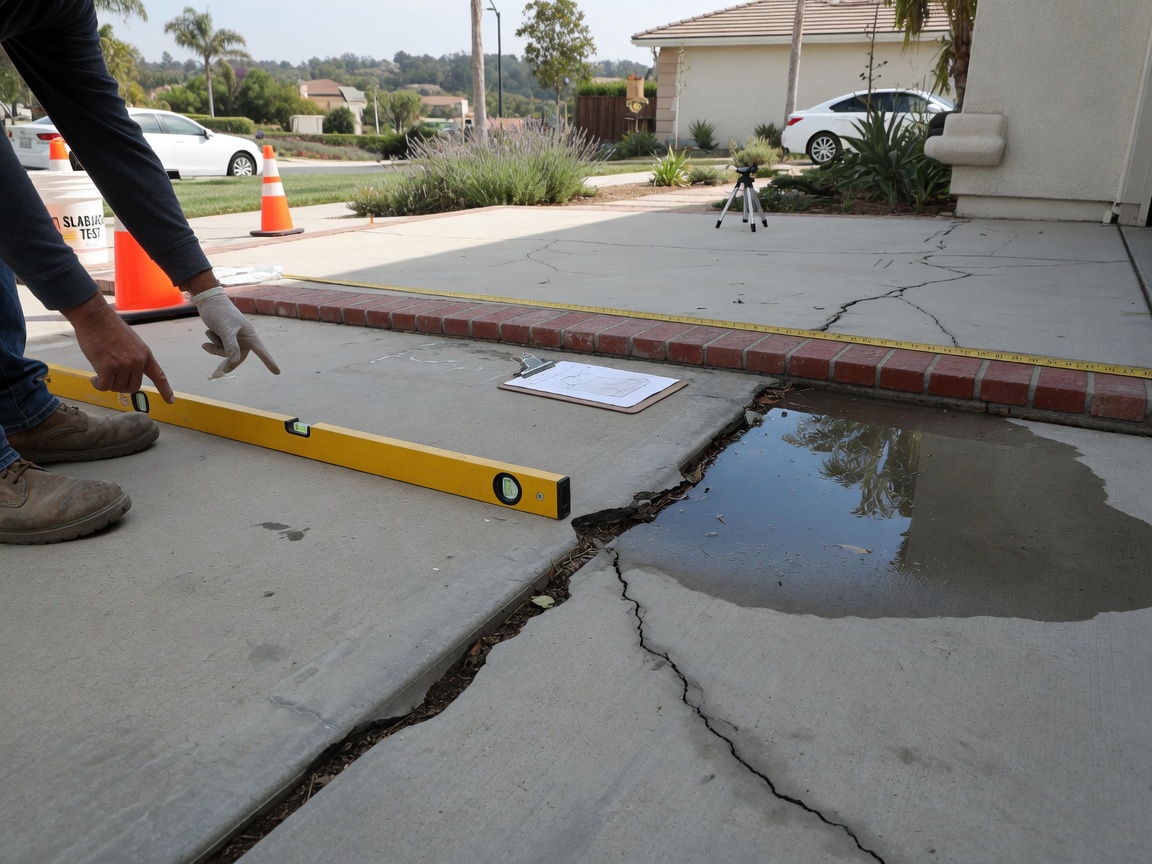
Checking a driveway or patio slab before mudjacking takes about 15–20 minutes with a garden hose, a flashlight, and a screwdriver — and it tells you whether the slab is a good candidate for concrete leveling mudjacking or whether it needs replacement instead. The short version: look for the size and pattern of cracks, tap-test for hollow spots, check how much the slab has actually settled, and confirm water is draining away rather than pooling under it. Slabs that pass these checks lift cleanly and hold for years; slabs that fail them often crack further or sink again within a season, even with fresh grout pumped underneath.
Why Irvine's Soil And Housing Stock Matter Here
Most of the slabs I inspect in Woodbury, Northwood, and Oak Creek were poured during Irvine's big development waves from the 1990s through the 2010s, on graded lots with expansive clay subsoil common across inland Orange County. That clay swells slightly with the rare heavy winter rain and shrinks back during our long dry stretch of warm summers, and that repeated cycle is what hollows out the base under a slab over years, even without any visible surface damage. Newer neighborhoods like Portola Springs and Great Park sit on more recently compacted fill, so I often see less settlement there than in the older sections near University of California Irvine and Quail Hill, where irrigation runoff has had two or three decades to wash fines out from under walkways and patios.
Step 1: Map The Cracks
Not every crack means the slab is unfixable, but the pattern tells you a lot:
- Hairline cracks under 1/8 inch running in one direction usually mean shrinkage during curing — mudjacking still works fine.
- Cracks wider than 1/4 inch with one side higher than the other indicate real settlement — a strong mudjacking candidate.
- Spiderweb or multi-directional cracking across a large section often means the slab itself is too broken to lift as one piece.
- Cracks radiating from a corner usually point to a void right under that corner, which is one of the easiest and cheapest spots to fix.
Walk the whole driveway or patio slow, in daylight, and mark cracks with chalk so you can compare width and direction section by section.
Step 2: Tap-Test For Hollow Spots
Take a hammer or a heavy screwdriver handle and tap across the surface every 12–18 inches in a grid. A solid slab gives a sharp, consistent knock. A hollow void underneath sounds duller and slightly higher-pitched, almost like tapping on a countertop over an empty cabinet versus a filled one. This is the single most useful DIY check because it tells you exactly where the base has eroded, which is what a crew pumping grout actually needs to know before drilling injection holes.